
Transparency
-
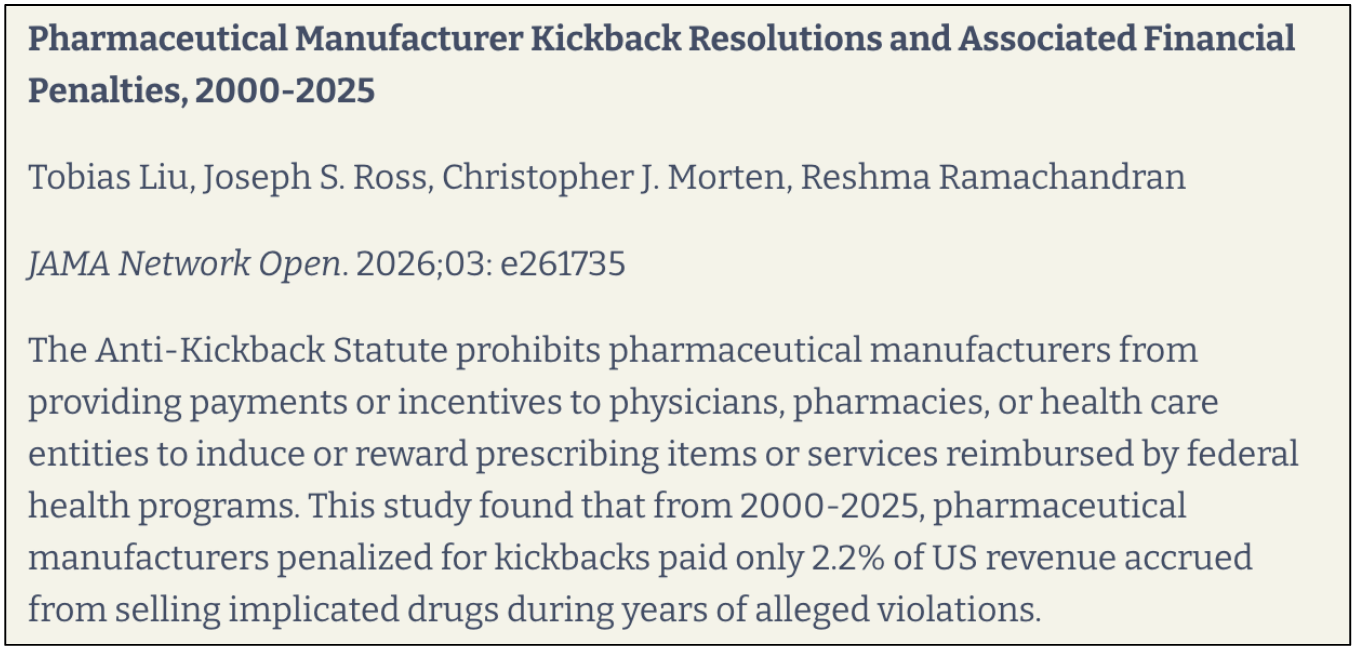
Pharmaceutical Manufacturer Kickback Resolutions and Associated Financial Penalties, 2000-2025
Tobias Liu, Joseph S. Ross, Christopher J. Morten, Reshma Ramachandran
JAMA Network Open. 2026;03: e261735
The Anti-Kickback Statute prohibits pharmaceutical manufacturers from providing payments or incentives to physicians, pharmacies, or health care entities to induce or reward prescribing items or services reimbursed by federal health programs. This study found that from 2000-2025, pharmaceutical manufacturers penalized for kickbacks paid only 2.2% of US revenue accrued from selling implicated drugs during years of alleged violations.
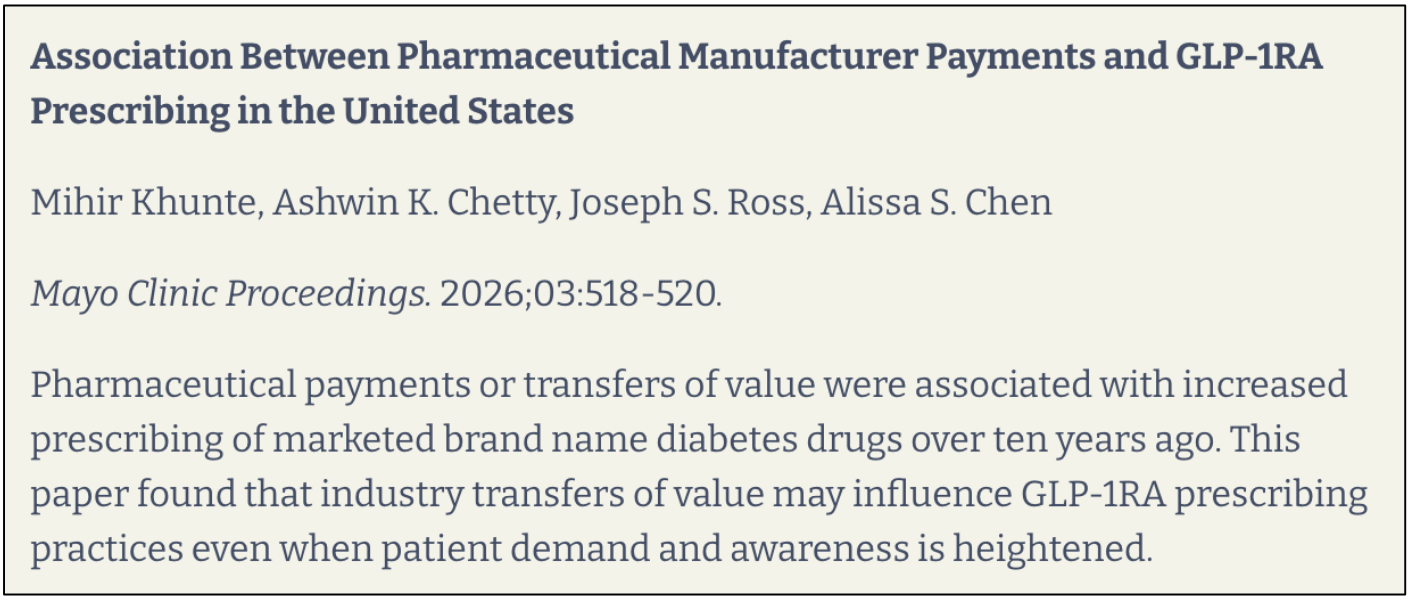
Mihir Khunte, Ashwin K. Chetty, Joseph S. Ross, Alissa S. Chen
Mayo Clinic Proceedings. 2026;03:518-520.
Pharmaceutical payments or transfers of value were associated with increased prescribing of marketed brand name diabetes drugs over ten years ago. This paper found that industry transfers of value may influence GLP-1RA prescribing practices even when patient demand and awareness is heightened.
-
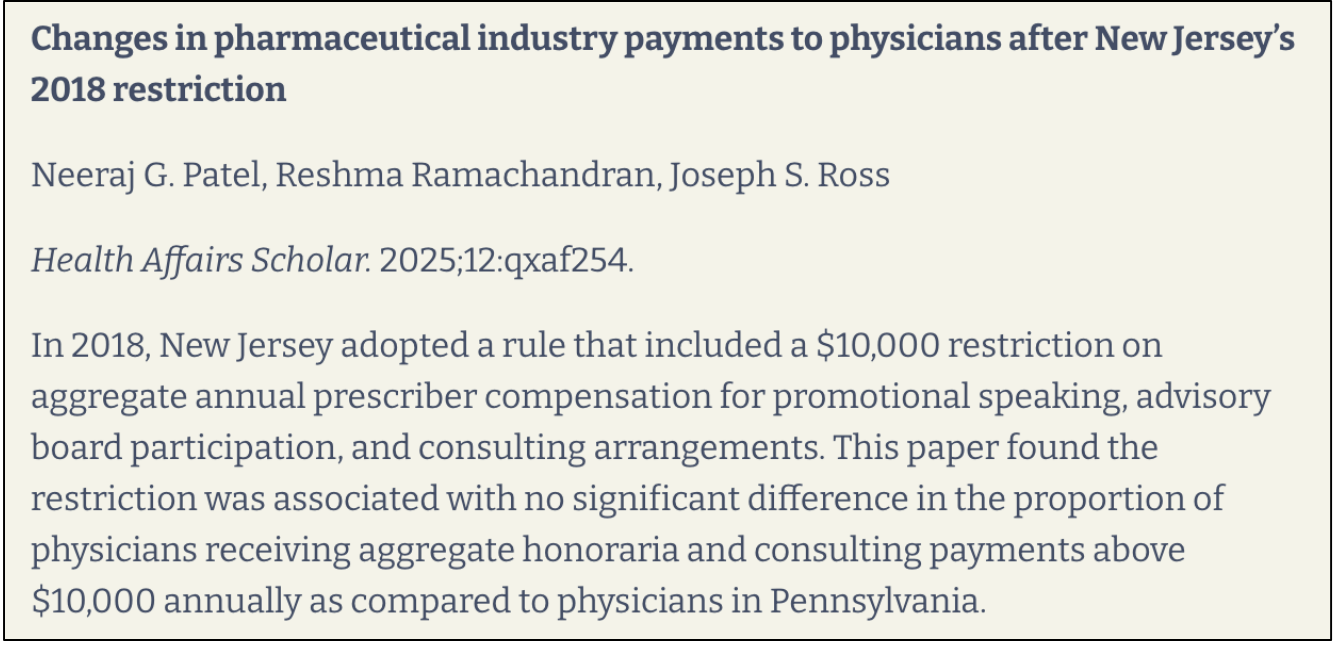
Changes in pharmaceutical industry payments to physicians after New Jersey's 2018 restriction
Neeraj G. Patel, Reshma Ramachandran, Joseph S. Ross
Health Affairs Scholar. 2025;12:qxaf254.
In 2018, New Jersey adopted a rule that included a $10,000 restriction on aggregate annual prescriber compensation for promotional speaking, advisory board participation, and consulting arrangements. This paper found the restriction was associated with no significant difference in the proportion of physicians receiving aggregate honoraria and consulting payments above $10,000 annually as compared to physicians in Pennsylvania.
Industry promotion of oncology drugs with accelerated approval that failed confirmatory trials
Maryam Mooghali, Reshma Ramchandran, Ayman Mohammad, Aaron P. Mitchell
Journal of the National Cancer Institute. 2025;08:936-940.
Industry payments to physician’s influence prescribing, raising concern for drugs granted accelerated approval that failed confirmatory studies. This study found from 2009-2021, of the 73 drugs granted accelerated approval, 6 (8.2%) had negative confirmatory studies and available OpenPayments data, and industry continued to promote certain drugs after confirmatory studies failed until drugs were withdrawn from market.
Access to Information Cited in National Organization for Rare Disorders Reports
Mengyuan Fu, Kexin Ling, Xinyi Zhou, Sneha Dave, Can Li, Luwen Shi, Xiaodong Guan, Joseph S. Ross
JAMA Network Open. 2025;05:e2511758.
As steps have been taken to promote public access to research results, patient organizations, such as the National Organization for Rare Disorders (NORD), facilitate access to high-quality information for patients and families. This study found that 50.1% of information sources cited in NORD rare-disease reports were not publicly available.
-
Industry Payments to Physicians by Competing Manufacturers Within Novel Therapeutic Classes
Q. Wilton Sun, Joseph S. Ross
JAMA. 2024;11:2111-2113.
Pharmaceutical manufacturers make extensive payments to physicians which have influence on prescribing practices. This study found between 40% and 90% of physicians already receiving payments from manufacturers of 6 first-in-class agents received payments from competing manufacturers by the fourth to fifth year following subsequent approvals.
Adoption of the voluntary conflict of interest statement on PubMed
Stephanie Rogus, Joseph S. Ross, Peter Lurie
PLOS ONE. 2024;10:e0308782.
In 2017, the National Library of Medicine (NLM) added a voluntary field for conflict of interest (COI) statements on the abstract page of PubMed. This paper found that the proportion of journals with at least one article with a posted COI statement increased from 25.9% in 2016 to 33.2% in 2021, and the proportion of articles that included a posted COI also increased from 9.0% in 2016 to 43.0% in 2021.
National Trends in and Concentration of Industry Payments to U.S. Psychiatrists, 2015–2021
John L. Havlik, Lydia Ososanya, Deanna Tang, Syed Wahid, Joseph S. Ross, Taeho Greg Rhee
Psychiatric Services. 2024;10:210-213.
Associations between industry payments and the prescribing behaviors of physicians are now well established, but payments to psychiatrists remain poorly characterized. This study found that from 2015-2021, of 56,955 psychiatrists, 75.0% received any industry payments, totaling $357,971,774.
Consent Form Reporting on ClinicalTrials.Gov, 2013-2023
Sydney A. Axson, Reshma Ramchandran, Alexa Lisenby, Nicholas A. Giordano
JAMA Network Open. 2024;06:e2418895.
Informed consent documentation is legally, ethically, and scientifically imperative for research and provides prospective trial participants key study information. This paper found that from 2013-2023 consent form availability improved over time, yet time to posting often exceeded 60 days even after the revised rule for NIH-funded trials on ClinicalTrials.gov.
Industry Payments to US Physicians by Specialty and Product Type
Ahmed Sayed, Joseph S. Ross, John Mandrola, Lisa Soleymani Lehmann, Andrew J. Foy
JAMA. 2024;03:1325-1327.
There is evidence that financial conflicts of interest may influence physician prescribing and may damage patients’ trust in medical professionals. This paper found that from 2013-2022, 85,087,744 payments with a total value of $12.13 billion were made by industry to 826,313 of 1, 445, 944 eligible physicians.
-
Medical Product Industry Ties to Patient Advocacy Organizations’ Executive Leadership
Shamik Bhat, Joseph S. Ross, Reshma Ramachandran
JAMA Internal Medicine. 2023;08:1164-1166.
While patient advocacy organizations advance patient interests through policy engagement, promotion of disease awareness, and partnerships with the pharmaceutical industry, many accept industry financial support, which may influence priorities. This study found that among the 50 highest-revenue PAOs in the US, three-fourths had board members, senior paid staff, or executives with prior or current ties to the pharmaceutical and medical device industries.
Transparency of Results Reporting in Cancer Clinical Trials
Jennifer Kao, Joseph S. Ross, Jennifer E. Miller
JAMA Network Open. 2023;08:e2328117.
There have been decades-long efforts to improve results reporting for clinical trials, however, problems still persist. This study found that one-third of oncology clinical trials reported results in at least 1 of 3 platforms (ClinicalTrials.gov, publications, or ASCO Annual Meetings) within 1 year of completion and just over half within 3 years.
Anisa Rowhani-Farid, Mikas Grewal, Steven Solar, Allen O. Eghrari, Audrey D. Zhang, Cary P. Gross, Harlan M. Krumholz, Joseph S. Ross
Scientific Data. 2023;08:529.
The impact and effectiveness of clinical trial data sharing initiatives may differ depending on the data sharing model used. This study found that from 2010-2013, National Heart, Lung, and Blood Institute’s centralized data sharing model was associated with more trials sharing data and more shared data publications when compared with the National Cancer Institute’s decentralized model.
Evidence of publication bias in multiple sclerosis clinical trials: a comparative analysis of published and unpublished studies registered in ClinicalTrials.gov
Alejandro Rivero-de-Aguilar, Mónica Pérez-Ríos, Alberto Ruano-Raviña, Cristina Candal-Pedreira, Marilina Puente-Hernandez, Joseph S. Ross, Leonor Varela-Lema
Journal of Neurology, Neurosurgery, & Psychiatry. 2023;07:597-604.
Complete and timely publication of clinical trials ensures that patients and the medical community are fully informed when making treatment decisions. This study found that between 2010-2019, Phase III and IV clinical trials on multiple sclerosis drugs are prone to under-reporting and publication bias.
Maryam Mooghali, Laura Glick, Reshma Ramachandran, Joseph S. Ross
BMJ Open. 2023;01:e069115.
Inaccurate disclosure of financial COI could undermine the integrity of clinical practice guidelines and diminish physician and patient confidence in their recommendations. This study found that among 270 US physician authors of 20 clinical practice guidelines, 101 (37.4%) disclosed industry-related financial COIs, whereas 199 (73.7%) were found to have received payments from industry when accounting for payments disclosed through Open Payments.