
Coverage and Affordability
-
Novel Drug Launches in Most-Favored-Nation Countries and Medicare Pricing Benchmarks
Mengyuan Fu, Rohini Ghosh, Erfan Taherifard, Reshma Ramachandran, Joseph S. Ross
JAMA Health Forum. 2026;07:e262340.
To lower the price of prescription drugs for Medicare beneficiaries, the CMS proposed Global Benchmark for Efficient Drug Pricing (GLOBE) and Guarding US Medicare Against Rising Drug Costs (GUARD). This paper found that of single-source drugs and biologics likely eligible for GLOBE and GUARD models, approximately 60% had launched in more than 1 MFN country within 1 year after US launch, but only 40% in countries with combined adult populations comparable with Medicare, and only 1% in countries with comparable combined drug expenditures.
Commercial Price Variation for Common Dermatologic Procedures
Chelsea Deitelzweig, Ravi Dhawan, Kyle King, Joshua J. Skydel, Reshma Ramachandran, Joseph S. Ross, Howa Yeung, Joshua D. Wallach
JAMA Dermatology. 2026;06:845-848.
In the US, demand for dermatologic procedures has increased over recent decades. Procedure prices have also increased, potentially associated with market consolidation and private equity investment in dermatology practices. This study found median payer-negotiated prices were generally lower than list prices, higher than Medicare prices, and lower for rural vs nonrural hospitals.
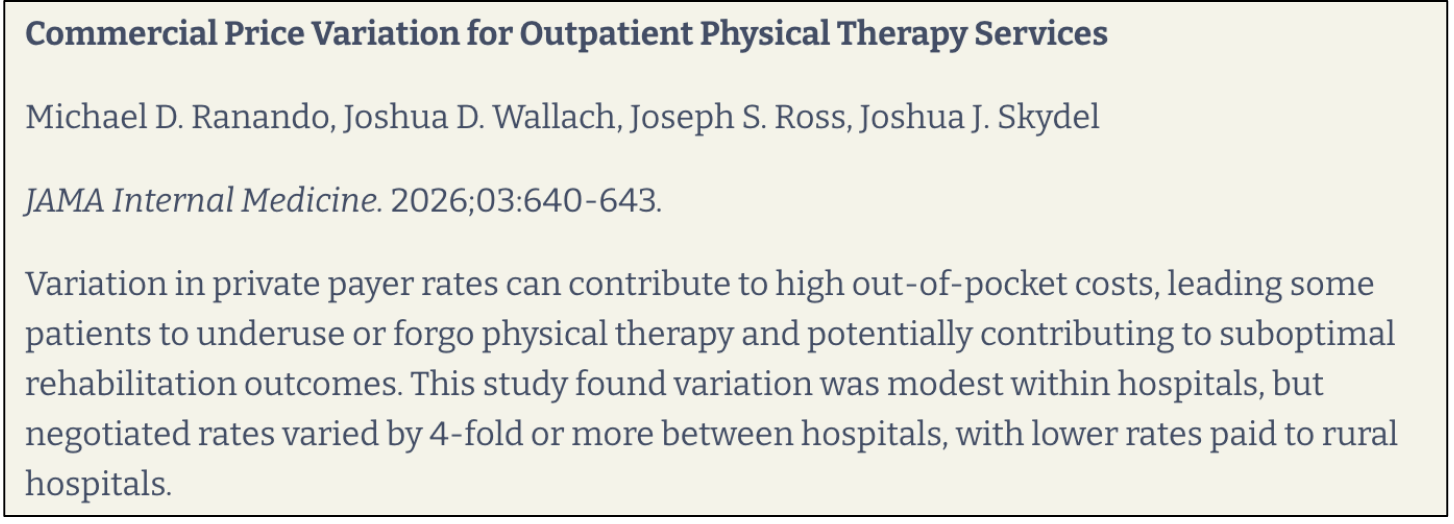
Commercial Price Variation for Outpatient Physical Therapy Services
Michael D. Ranando, Joshua D. Wallach, Joseph S. Ross, Joshua J. Skydel
JAMA Internal Medicine. 2026;03:640-643.
Variation in private payer rates can contribute to high out-of-pocket costs, leading some patients to underuse or forgo physical therapy and potentially contributing to suboptimal rehabilitation outcomes. This study found variation was modest within hospitals, but negotiated rates varied by 4-fold or more between hospitals, with lower rates paid to rural hospitals.
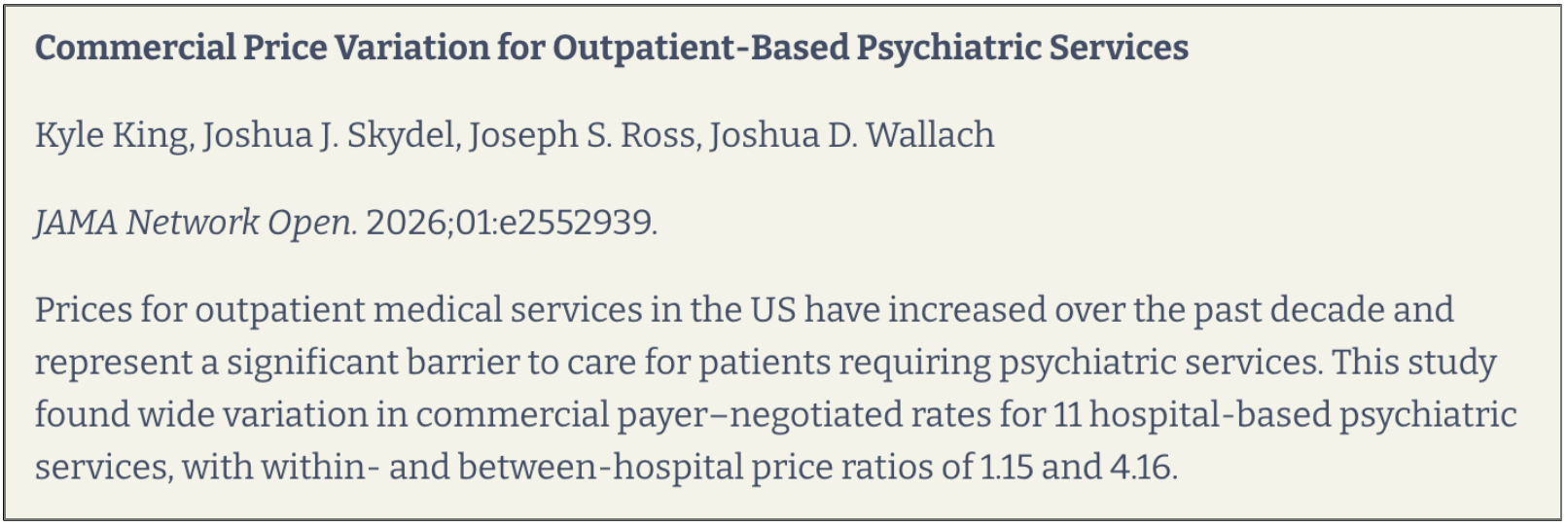
Commercial Price Variation for 11 Outpatient-Based Psychiatric Services
Kyle King, Joshua J. Skydel, Joseph S. Ross, Joshua D. Wallach
JAMA Network Open. 2026;01:e2552939.
Prices for outpatient medical services in the US have increased over the past decade and represent a significant barrier to care for patients requiring psychiatric services. This study found wide variation in commercial payer–negotiated rates for 11 hospital-based psychiatric services, with within- and between-hospital price ratios of 1.15 and 4.16.
-
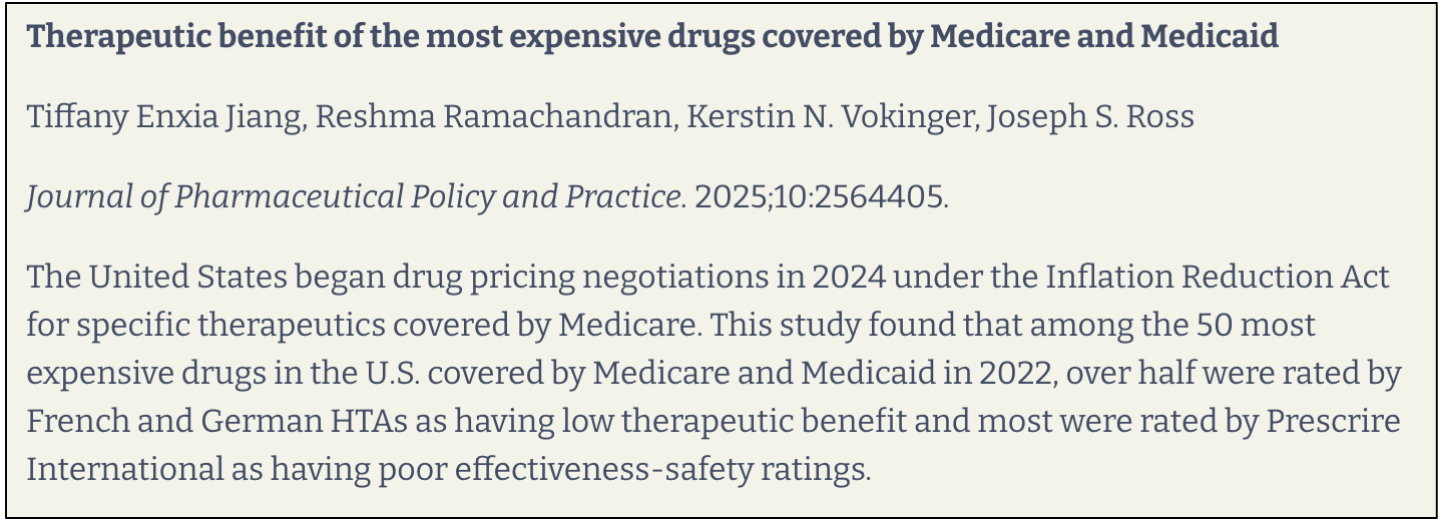
Therapeutic benefit of the most expensive drugs covered by Medicare and Medicaid
Tiffany Enxia Jiang, Reshma Ramachandran, Kerstin N. Vokinger, Joseph S. Ross
Journal of Pharmaceutical Policy and Practice. 2025;10:2564405.
The United States began drug pricing negotiations in 2024 under the Inflation Reduction Act for specific therapeutics covered by Medicare. This study found that among the 50 most expensive drugs in the U.S. covered by Medicare and Medicaid in 2022, over half were rated by French and German HTAs as having low therapeutic benefit and most were rated by Prescrire International as having poor effectiveness-safety ratings.
Revenue, Patents, and New Generic Competition for Prescription Drugs in the USA
S. Sean Tu, Aaron S. Kesselheim, Joseph S. Ross, Ravi Gupta
Journal of General Internal Medicine. 2025;07:245-248.
High brand-name drug prices decrease after a generic drug enters the market, which occurs approximately 13 years after FDA approval of the original small-molecule drug. This study found greater brand-name drug revenue was associated with more approved generics in the first year of generic competition, while more brand-name drug patents were associated with fewer generic competitors.
Insulin rationing in states with and without insulin copay caps: a cross-sectional study
Tiffany Enxia Jiang, Reshma Ramachandran, Kasia Lipska, Joseph S. Ross
Health Affairs Scholar. 2025;05:qxaf100.
Over the past 20 years, out-of-pocket copay costs associated with insulin have grown, leading to an affordability crisis among patients and widespread insulin rationing. This paper found no differences in insulin rationing and diabetes management-related stress between adults with diabetes using insulin who lived in states with and without insulin copay caps.
Research Derived From Medicare’s Coverage With Evidence Development Program
Guneet S. Janda, Osman Moneer, Maryam Mooghali, Reshma Ramachandran, Joshua D. Wallach, Sanket S. Dhruva, Joseph S. Ross
JAMA Network Open. 2025;04:e255077.
Medicare’s Coverage with Evidence Development program requires beneficiary participation in clinical studies as a condition of coverage for an item or service. This study found of all 26 items and services with CED program requirements, approximately half of 116 CED-approved studies had reported results as of July 2023, totaling 556 unique publications, even though fewer than one-third had been completed.
Maryam Mooghali, Osman Moneer, Guneet S. Janda, Joseph S. Ross, Sanket S. Dhruva, Reshma Ramachandran
Clinical Trials. 2025;02:619-625.
In 2005, CMS introduced the Coverage with Evidence Development program for items and services with limited evidence of benefit and harm for Medicare beneficiaries. This paper found from 2005-2023, required studies more often used randomized study designs, had larger patient populations, enrolled US patients, and focused on clinical outcomes as primary endpoints than studies used to inform initial National Coverage Determinations.
Mohammed Essa, Joseph S. Ross, Sanket S. Dhruva, Nihar R. Desai, Erica S. Spatz, Kamil F. Faridi
Journal of the American Heart Association. 2025;01:e034682.
The 2022 Inflation Reduction Act addresses high prescription drug costs by introducing price negotiation for selected Medicare Part D drugs. This study found between 2012-2021, there have been substantial increases in Medicare Part D claims and spending for the 10 medications selected for negotiation under the IRA.
Assessing Medicare’s Coverage With Evidence Development Program
Maryam Mooghali, Osman Moneer, Guneet Janda, Sanket S. Dhruva, Joseph S. Ross, Reshma Ramachandran
Health Affairs. 2025;01:32-39.
The CMS coverage with evidence development (CED) program provides coverage for items and services not meeting Medicare’s “reasonable and necessary” standard while requiring participation in clinical studies. This paper found CMS’s reliance on non-CED-approved studies for CED reconsiderations, despite CED-approved studies being higher quality and more representative of Medicare beneficiaries.
-
Medicare Local Coverage Determinations: Evidence Quality Is Stronger For Covered Indications
Osman Moneer, Maryam Mooghali, Khadeeja Moosa, Reshma Ramachandran, Joseph S. Ross, Sanket S. Dhruva
Health Affairs. 2024;12:1712-1718.
Under the 21st Century Cures Act of 2016, a summary of the evidence used to support local coverage determinations, which represent the vast majority of Medicare's coverage decisions for new technologies, must be made publicly accessible. This paper found that from 2015-2022, there was no significant association between indication coverage and the study design strength of cited clinical studies.
Representativeness of Studies Required Under Medicare’s Coverage With Evidence Development Program
Maryam Mooghali, Sanket S. Dhruva, Joseph S. Ross, Reshma Ramachandran
JAMA. 2024;11:1943-1945.
Medicare beneficiaries are often inadequately represented in clinical studies supporting FDA medical product approvals. This study found coverage with evidence development approved studies were larger and more frequently reported demographic data than studies informing initial coverage decisions.
Estimating The Effects Of COVID-19 On Globalized Markets For Active Pharmaceutical Ingredients
Melissa J. Barber, Reshma Ramachandran, Suerie Moon
Health Affairs. 2024;07:959-969.
Global supply chains for active pharmaceutical ingredients (APIs) are highly centralized in certain countries and are susceptible to supply-chain shocks, but there is no global coordination to monitor risk. This paper found that API prices for essential medicines not used for COVID-19 did not change significantly in the year after the WHO pandemic declaration, but volume decreased by 80%.
Estimated Sustainable Cost-Based Prices for Diabetes Medicines
Melissa J. Barber, Dz intars Gotham, Helen Bygrave, C hrista Cepuch
JAMA Network Open. 2024;03:e243474.
The costs associated with diabetes put substantial pressure on patients and health budgets, especially in low- and middle-income countries. This study found that for nearly all insulins, SGLT2Is, and GLP1As, in nearly all countries surveyed, prices could be reduced substantially if robust generic/biosimilar manufacture was enabled.
Omar Qureshi, Reshma Ramachandran, Joseph S. Ross
Journal of Pharmaceutical Policy and Practice. 2024;02:2312374.
The 2022 Inflation Reduction Act allows CMS to directly negotiate with drug manufacturers on Medicare prices of high-expenditure drugs which meet certain eligibility criteria. This paper found from 2016-2019, approximately one third (33.3% for Part B, 32.4% for Part D) of high-expenditure Medicare drugs would have been eligible for negotiation.
-
Angela Lu, Robin Z. Ji, Alex Y. Ge, Joseph S. Ross, Reshma Ramachandran, Rita F. Redberg, Sanket S. Dhruva
JAMA. 2023;08:1094-1096.
CMS issues National Coverage Determinations (NCDs) for services or products with questions regarding effectiveness or newly available evidence, among other reasons. This study found that for CMS NCDs of medical devices, nearly all physicians, teaching hospitals, and organizations that submitted public comments supported expanding coverage.