
Safety and Efficacy
-
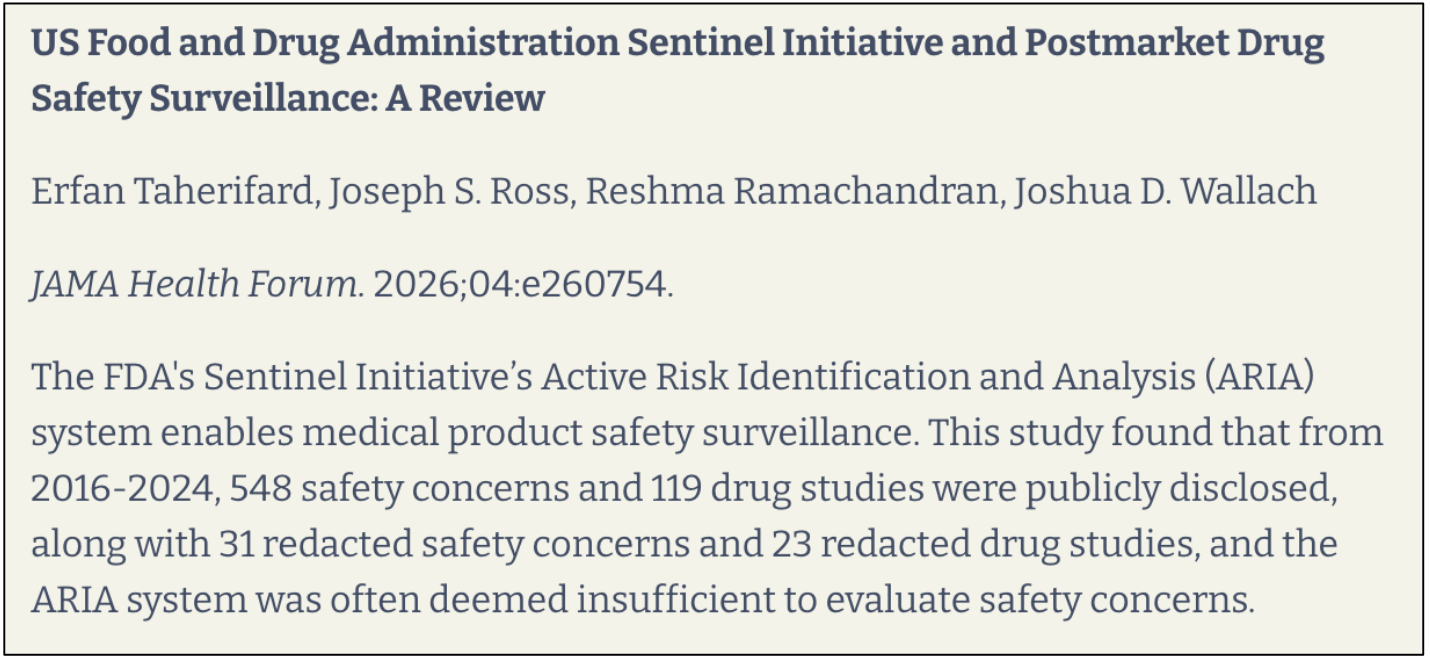
Erfan Taherifard, Joseph S. Ross, Reshma Ramachandran, Joshua D. Wallach
JAMA Health Forum. 2026;04:e260754.
The FDA's Sentinel Initiative’s Active Risk Identification and Analysis (ARIA) system enables medical product safety surveillance. This study found that from 2016-2024, 548 safety concerns and 119 drug studies were publicly disclosed, along with 31 redacted safety concerns and 23 redacted drug studies, and the ARIA system was often deemed insufficient to evaluate safety concerns.
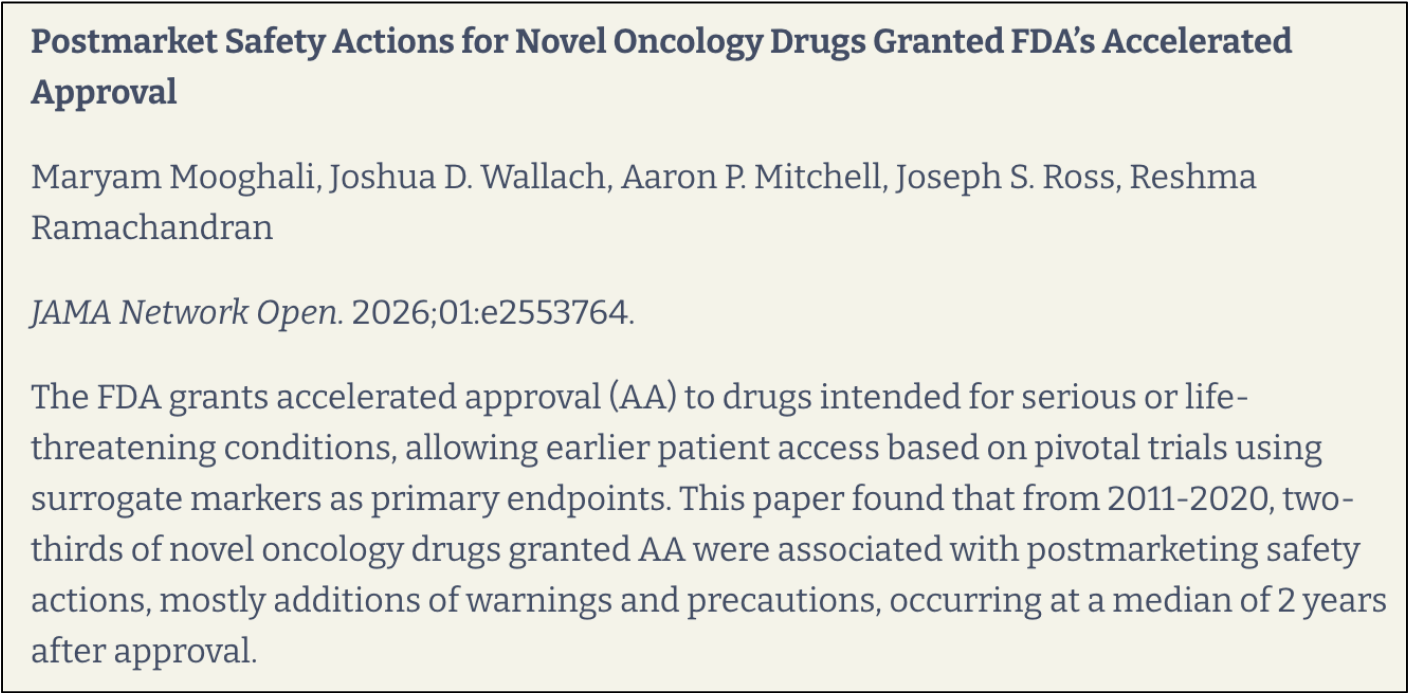
Postmarket Safety Actions for Novel Oncology Drugs Granted FDA's Accelerated Approval
Maryam Mooghali, Joshua D. Wallach, Aaron P. Mitchell, Joseph S. Ross, Reshma Ramachandran
JAMA Network Open. 2026;01:e2553764.
The FDA grants accelerated approval (AA) to drugs intended for serious or life-threatening conditions, allowing earlier patient access based on pivotal trials using surrogate markers as primary endpoints. This paper found that from 2011-2020, two-thirds of novel oncology drugs granted AA were associated with postmarketing safety actions, mostly additions of warnings and precautions, occurring at a median of 2 years after approval.
-
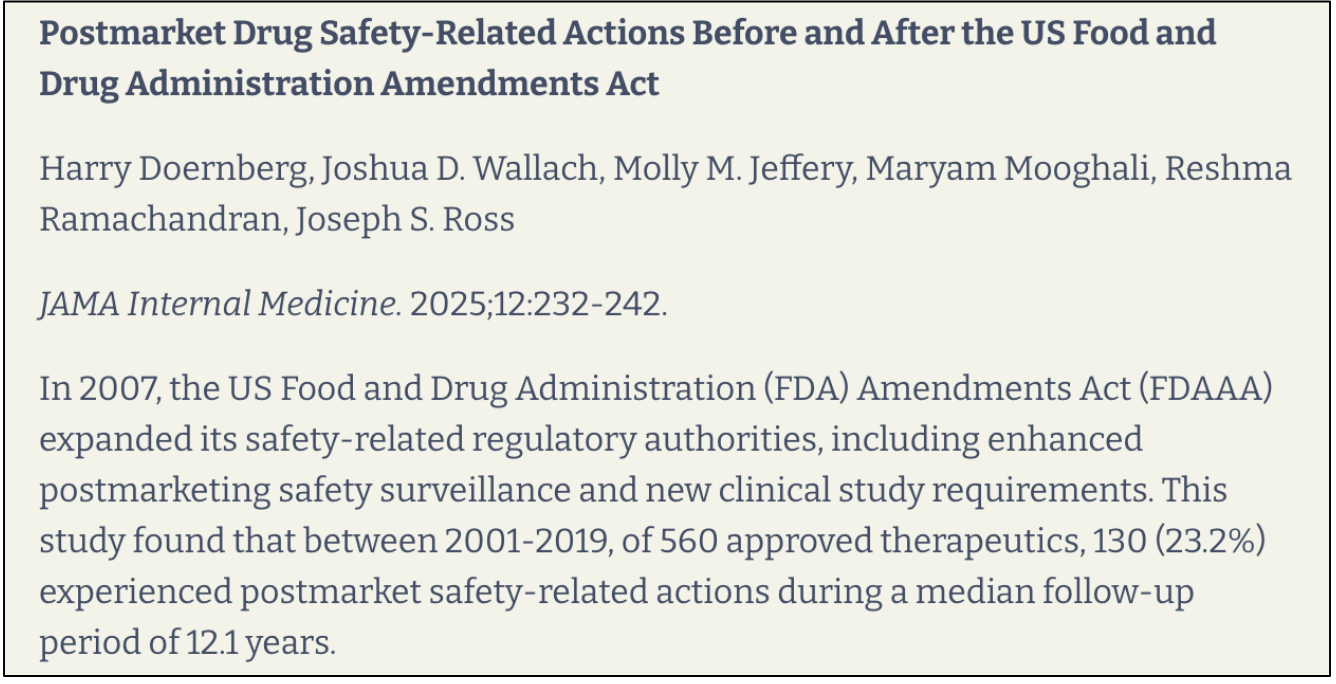
Harry Doernberg, Joshua D. Wallach, Molly M. Jeffery, Maryam Mooghali, Reshma Ramachandran, Joseph S. Ross
JAMA Internal Medicine. 2025;12:232-242.
In 2007, the US Food and Drug Administration (FDA) Amendments Act (FDAAA) expanded its safety-related regulatory authorities, including enhanced postmarketing safety surveillance and new clinical study requirements. This study found that between 2001-2019, of 560 approved therapeutics, 130 (23.2%) experienced postmarket safety-related actions during a median follow-up period of 12.1 years.
Carla Barile Godoy, Reshma Ramachandran, Pradyumna Sapre, Joseph S. Ross
Clinical Trials. 2025;10:109-112.
A single pivotal trial may also be sufficient for FDA approval if safety and efficacy is clearly and convincingly demonstrated, or if accompanied by confirmatory evidence. This paper found that from 2015-2023, 181 (41%) approvals were based on 2 or more pivotal trials, 35 (7.9%) on a single pivotal trial with at least one clinical primary efficacy endpoint without orphan designation, and 185 (42%) on a single pivotal trial.
Early Recalls and Clinical Validation Gaps in Artificial Intelligence-Enabled Medical Devices
Branden Lee, Patrick Kramer, Sara Sandri, Ritika Chanda, Crystal Favorito, Olivia Nasef, Joseph S. Ross, Joshua Sharfstein, Tinglong Dai
JAMA Health Forum. 2025;08:e253172.
Artificial intelligence–enabled medical devices (AIMDs) are increasingly present in US clinical practice, with nearly all cleared through the FDA 510(k) pathway. This study found that among 950 AIMDs, 60 (6.3%) were associated with 182 recall events but were concentrated early after clearance and predominantly involved products lacking clinical validation and manufactured by publicly traded companies.
Yichen Zhang, Dingyi Chen, Mengyuan Fu, Luwen Shi, Huseyin Naci, Anita K. Wagner, Joseph S. Ross, Xiaodong Guan
The Lancet Oncology. 2025;08:1252-1260.
Well-designed pivotal clinical trials can provide robust evidence for the market authorization of new cancer drugs, whereas lower-quality clinical evidence leads to uncertainty about drug benefits and harms. This study found 77 novel cancer drugs for 86 original and 62 supplemental indications approved in China from 2017-2021 with 44 (30%) indications supported by single-arm trials only and 104 (70%) supported by at least one RCT.
Jessica Morley, Joel Laitila, Joseph S. Ross, Joel Schamroth, Joe Zhang, Luciano Floridi
Minds and Machines. 2025;35:11.
There are more than 350,000 health apps available in public app stores, many of which are beneficial, but there are also concerns that poor-quality apps, marketed directly to consumers, threaten the tenets of evidence-based medicine and expose individuals to the risk of harm. This study found that less than half of the 220 apps (44%) audited state that they have evidence to support their claims of effectiveness.
-
Maryam Mooghali, Tianna Zhou, Joseph S. Ross
BMJ Open. 2024;10:e090376.
Direct oral anticoagulants, approved in the early 2010s, offer a unique opportunity to examine differences in premarket and postmarket evidentiary standards between regulatory agencies around the world. This study found there was a concordance in the phase 3 trial premarket evidence used to establish efficacy and safety of direct oral anticoagulant approvals across four major regulatory agencies but discordance in the phase 2 trial premarket evidence used and postmarket safety boxed warnings and postmarketing requirements.
Class I Recalls of Cardiovascular Devices Between 2013 and 2022: A Cross-Sectional Analysis
Claudia See, Maryam Mooghali, Sanket S. Dhruva, Joseph S. Ross
Annals of Internal Medicine. 2024;09:1499-1508.
Cardiovascular devices account for one third of all Class I recalls, the FDA's most severe designation. This study found that from 2013-2022, there were 137 Class I recall events affecting 157 unique cardiovascular devices, and recalled devices were infrequently subjected to premarket or postmarket testing.
-
Kerstein N. Vokinger, Aaron S. Kesselheim, Joseph S. Ross
BMJ. 2023;07:e074166.
After initial regulatory approval, a new prescription drug may subsequently be approved for additional indications, which is common for oncology drugs. This study found that from 2011-2020, the proportion of supplemental indications rated as having high therapeutic value was substantially lower than for first indications.
Meera M. Dhodapkar, Joseph S. Ross, Reshma Ramachandran
JAMA Network Open. 2023;06:e2318889.
The FDA announced the Split Real-Time Application Review (STAR) pilot program under the Prescription Drug User Fee Authorization Act VII in 2022. This paper found that of 146 supplemental new indications approved between 2017-2019, the median regulatory review time was 6 months.
Ashley Eadie, Andrea MacGregor, Joshua D. Wallach, Joseph S. Ross, Matthew Herder
BMJ Evidence-Based Medicine. 2023;05:151-156.
Disagreements among FDA reviewers regarding the recommendation for a novel therapeutic’s approval, its safety, the indicated patient population and/or other parameters of the drug’s approval are common. This study found that between 2011-2015, of 174 novel therapeutics approved, 42 (24%) had at least one regulatory reviewer disagreement , and altogether, 156 instances of disagreement were observed.
Meera M Dhodapkar, Xiaoting Shi, Reshma Ramachandran, Evan M. Chen, Joshua D. Wallach, Joseph S. Ross
BMJ. 2022;10:e071752.
Post-marketing pharmacovigilance is an essential component for monitoring drug safety, providing early identification of potential adverse events related to drugs through a combination of voluntary and active surveillance efforts. This paper found that from 2008-2019, 603 potential safety signals identified from the FAERS were reported by the FDA.